

How Standard Electric Supply Automated 95% of Manual AP Data Entry
Using Canals, Standard Electric replaced template-based automation with AI, decreasing time spent on manual entry and increasing invoice auto posting
95%
of manual entry automated
53%
increase in invoices fully auto posting
<4
weeks to see meaningful results

Standard Electric Supply Co is a fourth generation, family-owned, full-line electrical distributor with an emphasis on industrial automation and control products for the OEM and MRO markets. Their locations throughout Wisconsin, Illinois, and Indiana house over $55MM in inventory.


Before Canals
Standard Electric had already invested in automation with EDI and a template-based AP platform, but these efforts only automated 59% of their manual entry
- Their legacy provider only covered 25–50 suppliers
- Expenses were still routed to their 16 warehouse locations for manual approval
- Non-standard invoices, like handwritten and scanned PDFs couldn’t be processed automatically
Because the team was so busy just keeping up with daily invoices and expenses, unbilled credits went unrecovered and money was left on the table.
With Canals
After implementing Canals, Standard Electric was able to automate 95% of their manual entry. Invoices and expenses are processed faster and error rates are lower
- No template management is needed to handle all suppliers
- Expense approvals are automated end-to-end
- Handwritten & scanned invoices are processed by AI
Above and beyond these results, the team uncovered several benefits that weren’t in the original business case, including:
- The AP team now has time to proactively chase credit memos from suppliers
- Employees can take vacations without backlogs and chaos
- A solution they can rely on is in place: As one associate said, " I like coming to work”
Prior to Canals, our automation percentage was 59%. Now we’re down to 5% manual review. Our AP team wishes they had just started using Canals for everything sooner.


With almost two decades of accounting expertise and nine years at Standard Electric, Megan understands better than most the challenges of successfully running finances for an independent distributor. As VP of Finance, Megan oversees all accounting functions, including financial reporting, budgeting, insurance, financing, treasury management, accounts payable, accounts receivable, rebate claims, and payroll.
Hitting the Ceiling on Automation with Software
Standard Electric Supply has been a fixture of Midwest electrical distribution since 1919. With 16 locations across Indiana, Illinois, and Wisconsin, the company processes roughly 8,000 to 8,500 invoices every month.
By the time they found Canals, Standard Electric was already ahead of many peers on automation, but they'd hit a hard ceiling. Invoices from their largest suppliers were handled via EDI, and a legacy automation platform covered an additional 25 to 50 suppliers. Together, those tools pushed automation to around 59% of total invoice volume.
The remaining 41% still required human hands and precious hours or days of time.
Our dream was to have everything flowing into an automation tool. We thought we were going to get there, but we weren't able to, because of the limitations.
The template model of their former provider meant constant upkeep: deciding which suppliers to onboard, monitoring activity levels, and rebuilding templates whenever a supplier changed their invoice format. The team was spending time managing the automation system itself rather than benefiting from it.
Whenever the team received a document outside the conventions that their previous software could process, that still meant manual entry. Scanned PDFs, or even the occasional handwritten invoice also required human intervention to manually enter the data line by line.
Expenses were another time-consuming manual process. The team had to email every expense to warehouse managers at their 16 different locations for validation, wait for the responses, and invariably follow up with those managers when they didn’t receive a response.
In total, the original solution Standard Electric had implemented left too much work that humans still had to manage.
Core Challenges
- Template setup was labor-intensive, and combined with EDI, only achieved automation for 59% of invoice volume
- Expense invoice approval required emailing warehouse managers, waiting for responses, and following up on stragglers
- Scanned PDFs and handwritten invoices had to be processed entirely by hand
Up and Running in Days with Quick Integration and Immediate Value
Standard Electric came to Canals after hearing about the platform from another electrical distributor already using it. Crucially, Canals' deep familiarity with Eclipse meant there were no integration surprises. The Canals team knew Eclipse's quirks and had built for them.
Megan made a point to personally oversee the implementation. She expected it to take months based on prior experience with enterprise software rollouts. It didn't.
They sent us a document, and we just followed it. We were in and integrated, and everything was going smoothly. I kept waiting for it to get hard. It just didn't.
Within four weeks, Megan realized her AP team had the full Canals implementation and onboarding handled without her. It was so self-contained they could run it independently, supported by regular calls with their Customer Success Manager and same-day email responses from customer support when needed.
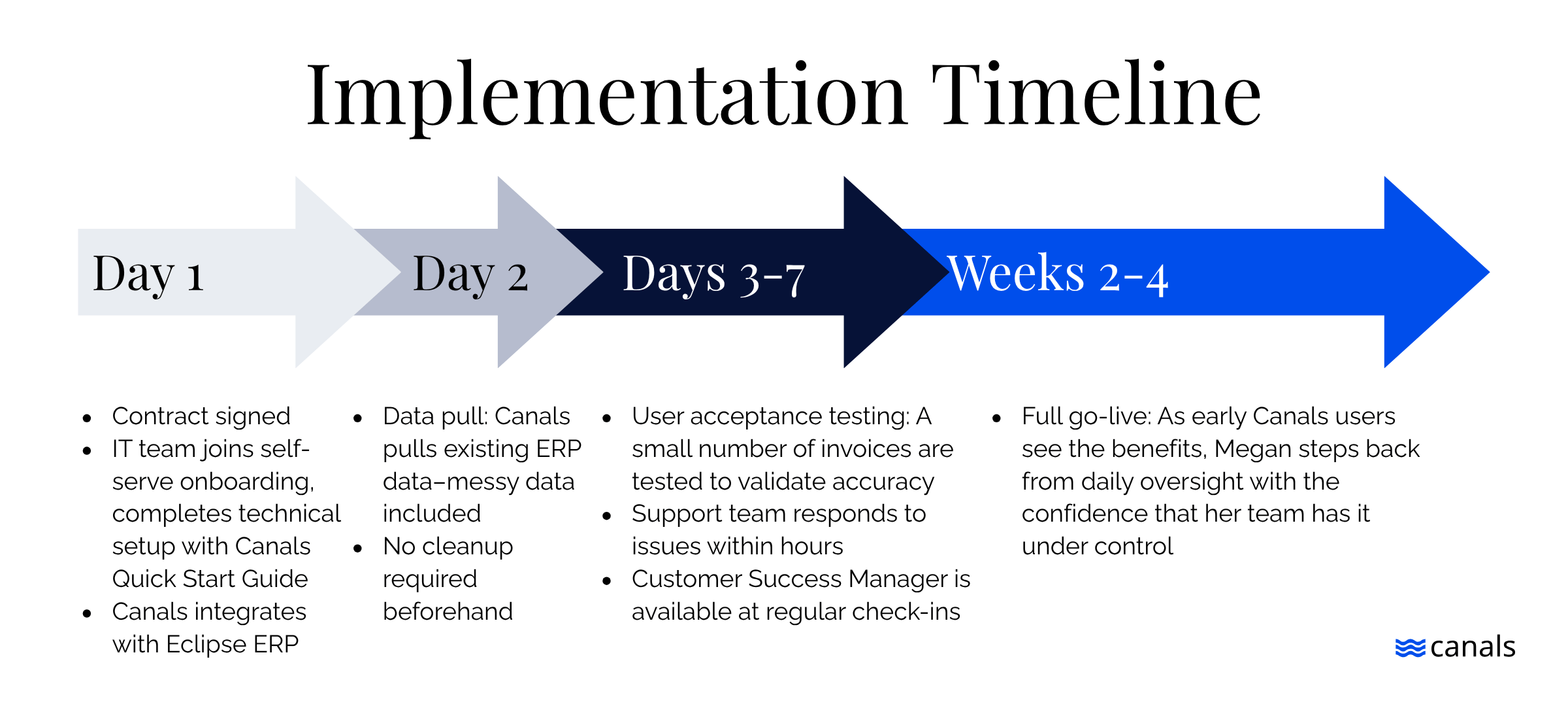
The AP staff's retrospective advice? "We wish we'd just opened the floodgates sooner." Since Canals adapted so quickly to their needs, there was little reason to phase the rollout. Any initial skepticism was quickly overcome.
One of our AP associates went to their inbox to process invoices after a call and realized there was nothing there. He came into my office and said, ‘I take it all back–it’s great.’
Key Benefits
- AI-powered automation reads invoices and creates payables without any template maintenance
- Three-way matching auto-links POs and receipts to the invoice, enabling autosubmission if everything matches
- Expense invoice routing is automated: no more email chains to warehouse managers, no more manual follow-ups
- Plug-and-play Eclipse integration required no heavy IT lift and the team went live in days, not months
- Regular customer success check-ins during onboarding; support tickets resolved in hours
The Impact of AI Workflow Automation
The numbers tell a clear story. Before Canals, 47% of invoices were autoposted. Now 72% of invoices are automatically posted. Manual data entry has dropped from 41% to just 5% of volume–and even that sliver is accounted for by edge cases like rebate credit memos that Canals is actively developing thanks to close collaboration with feedback from teams like Megan’s.
But automation rates only capture part of the value. The impact that Standard Electric's team didn't anticipate–and now talks about the most–is what their AP associates do with the time they've reclaimed.
The team is now working through a long-neglected unearned billed report–suppliers who owe Standard Electric credits but don't issue them unless asked. That reconciliation work, previously left undone because there was no bandwidth for it, is now converting directly into recovered cash. It's the kind of ROI that didn't appear in any pre-implementation forecast, but translates to real dollars saved.
There’s also a benefit that’s less quantifiable, but just as important: quality of life for Megan’s team. Before Canals, an associate wouldn’t even take more than a couple days’ vacation for fear of the backlog and necessary overtime she would face on return. Now, she’s able to take the vacation she deserves. The team has time to participate in company-wide culture events, feels more engaged, and is more satisfied at work now that they’re not swamped with tedious manual work.
In September, our two AP associates took back-to-back weeks of vacation. When I started here eight years ago, one of my associates told me she couldn't take more than two days off–she'd come back to a mess. Now they just comfortably do it.
Business Impact
- Unearned credits are being recovered as vendor statement cleanup is underway
- AP team eliminated overtime and saw improved morale
- Associates describe liking their jobs more as they are freed from high-volume clerical work
Canals Becomes a Benchmark Across the Company
Standard Electric's initial experience with Canals has spread beyond the AP department. The name itself has become shorthand for smooth implementation. When evaluating new technology projects internally, teams now ask: "Is this going to be a Canals-type project, or a [other-platform]-type project?"
Other departments are curious what Canals can do for them too. The VP of Warehouse Operations reached out to Megan asking when her team could use it–not because AP evangelized the platform, but because word traveled on its own.
As Penny Mingerink, VP of Warehouse Operations put it:
Everybody is using Canals and is so excited about it. When do I get to use it?
The takeaway for Megan boils down to how fully the tool addressed her team’s pain points. Now, Canals is tackling the vast majority of the team’s most tedious tasks–not just the “neat” cases–and freeing up her people to move faster with accuracy and confidence.
At the end of the day, the AP team’s success speaks for itself. Since seeing how much easier life can be, Standard Electric has expanded their Canals suite of solutions to include Sales Order Entry, Purchasing & Receiving as well as Accounts Receivable–more to come as this next chapter of their success story unfolds.
Advice for Other Distributors Looking into AI Workflow Automation
Megan's team wishes they'd moved faster. Their retrospective feedback after two months was simple: they could have moved their AP work to Canals faster. The platform adapts quickly enough that a cautious rollout is unnecessary.
- Start broad, not narrow: The team was ready far earlier than they anticipated to open the full invoice volume
- Empower your people: The real ROI extends beyond the time saved on data entry–it's what your team does with that time they save
- Stop asking "What's our AI strategy?": Ask "What work can we make better?" and the AI part follows naturally from there


